

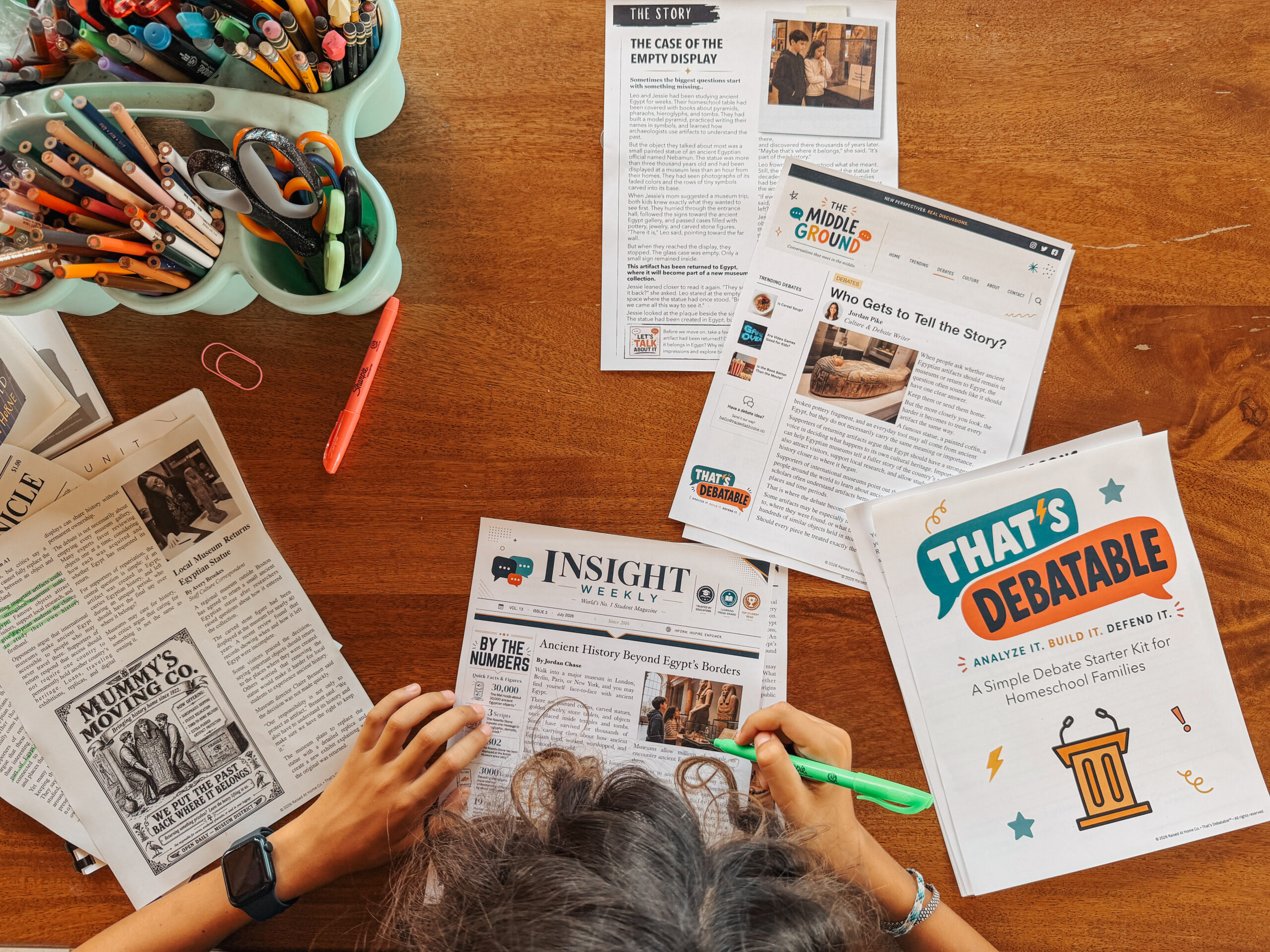
Wondering how to bring homeschool lessons to life with debate? When most people hear the word debate, they picture podiums, note cards, and high school speech teams.
That couldn’t be further from what it looks like in our house.
For us, debate has become one of the easiest ways to bring our homeschool to life. Not because I’m trying to raise future attorneys (although Lou and I both are attorneys). But because one great question has a funny way of turning into an afternoon of curiosity. A debate doesn’t end when someone makes their closing argument. If anything, that’s usually when the real learning begins. So if you’re wondering how That’s Debatable fits into your homeschool,
At the time I’m wriring this, we have 6 debate topics to choose from:
- Is Cereal a Soup?
- Are Video Games Good for Kids?
- Should Ancient Artifacts Be Returned to Egypt?
- Should We Bring Back Extinct Animals?
- Should Companies Direct Ads to Kids?
- Are Robots Good for Humanity?
Let me show you exactly how I’d use each one of the 6 topics to bring our homeschool lessons to life!
IS CEREAL A SOUP?
This one is just plain fun! It’s a great first topic to introduce the concept of debate. At first glance it just feels silly. And that’s exactly why I love it! Because sometimes, the best learning starts with a question that makes everyone laugh.
So picture this: I’d kick this one off at breakfast by serving bowls of cereal and asking “So…is cereal actually a soup?” I already know my boys would have strong opinions before anyone even picked up a research article.
After the debate, I’d lean into the rabbit trails. We might pull out a cookbook and compare different types of soups. What ingredients do they all have in common? Are there any official definitions? That night we could make homemade soup together, experiment in the kitchen, and maybe even invent our own recipe!
We could even sneak math into our lesson and survey family and friends, graph the results, and see if public opinion matches our own! I love this topic because it reminds me that meaningful learning doesn’t always have to begin with a textbook. Sometimes it begins with a bowl of cereal, a good question, and a family that’s willing to think a little deeper.
Perfect to use when you’re studying: nutrition or healthy eating; cooking and culinary arts; states of matter; scientific classification and categorizing; just for fun on a Friday
ARE VIDEO GAMES GOOD FOR KIDS?
When we did this debate in our house, my boys walked into it already convinced they knew the answer. So naturally, I assigned them the opposite view! Ha!
Instead of relying on their own experiences or repeating something they’ve heard, your kids will have to slow down, read the evidence, and consider viewpoints that they may not have thought about before.

After the debate, you can keep the conversation going by taking a closer look at the games your family already plays.
- Which games encourage creativity?
- Which ones require strategy or teamwork?
- Which ones are simply entertaining?
Here’s some great extension activities and conversation starters for after your debate:
-You can compare different game genres
-Learn a little about how video games are designed, and even talk about the psychology behind why they’re so engaging.
-Reflect on their own habits.
-Have a family game night – maybe play video games from parent’s childhood if possible.
-Ask if their opinion has changed after reading the research.
– Ask if they were making the rules for their own family, what would they recommend.
I love this topic because it teaches kids that good decisions aren’t made from assumptions. They’re made by gathering evidence, asking thoughtful questions, and being willing to reconsider what you thought you already knew.
Perfect to use when you’re studying: technology; media literacy; entrepreneurship (game development); computer science or coding; psychology; health and wellness
Should Ancient Artifacts Be Returned to Egypt?
If you’re studying Ancient Egypt this year, this debate is an absolute must. We actually just finished up ourself and the debate was such a great add on!
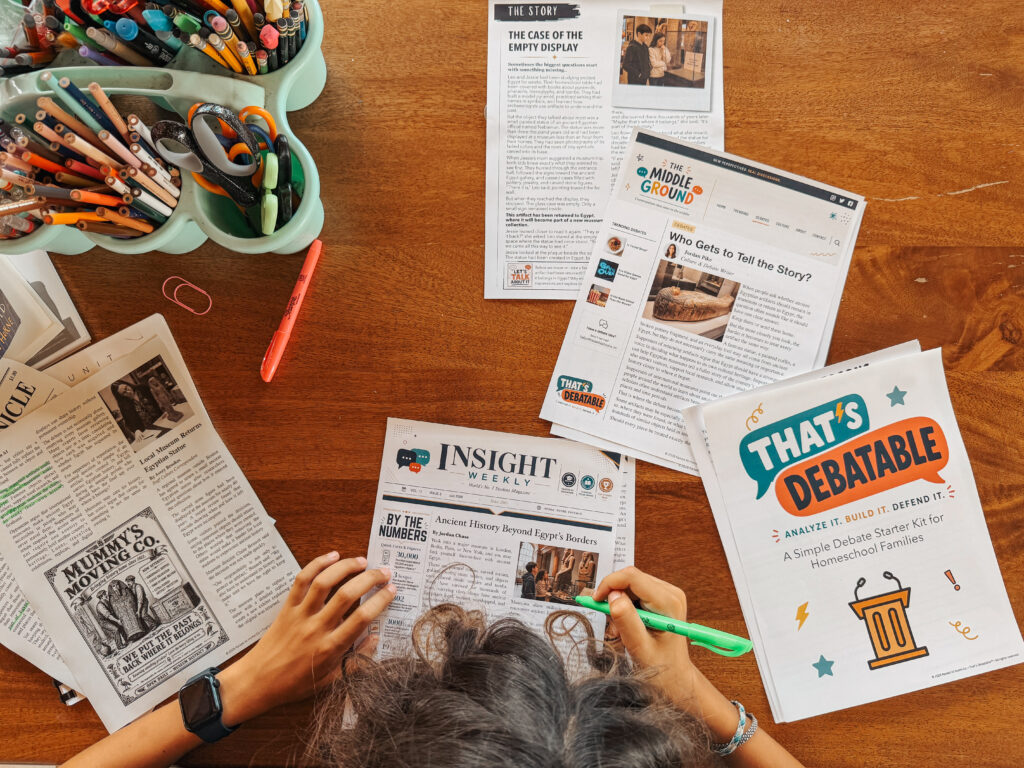
I love that it takes everything your kids are already learning about pyramids, pharaohs, archaeology, and ancient civilizations and asks them to think one step further. Instead of simply learning about history, they’re invited to participate in a conversation that’s still happening today.
Who should be responsible for preserving history? This is a great opportunity to study famous artifacts like the Rosetta Stone and bust of Nefertiti, learn how they ended up in museums around the world, and ask questions that don’t have easy answers. Should these artifacts stay where millions of people can see and learn from them? Or do they belong in the countries where they were originally discovered?
I also love that this debate can be used as an opportunity to explore museums around the world through virtual tours. It’s fascinating to see how many ancient artifacts are displayed far from the places they came from. You can even challenge your child to design their own exhibit and decide which artifacts they’d want to include in it. This debate reminds kids that history isn’t just about memorizing dates and events. It’s about people, perspectives, and the choices we continue to make about preserving the past.
Perfect to use when you’re studying: Ancient Egypt, Ancient Civilizations, Archaeology, Museums, Cultural Heritage, Ethics, Religious studies
Should We Bring Back Extinct Animals?
If you’re studying the Paleolithic Era or the Ice Age this year, this debate is such a natural fit. After spending time learning about early humans, changing climates, and the incredible animals that once roamed the Earth, this debate gives your kids the opportunity to wrestle with a question that’s surprisingly relevant today!
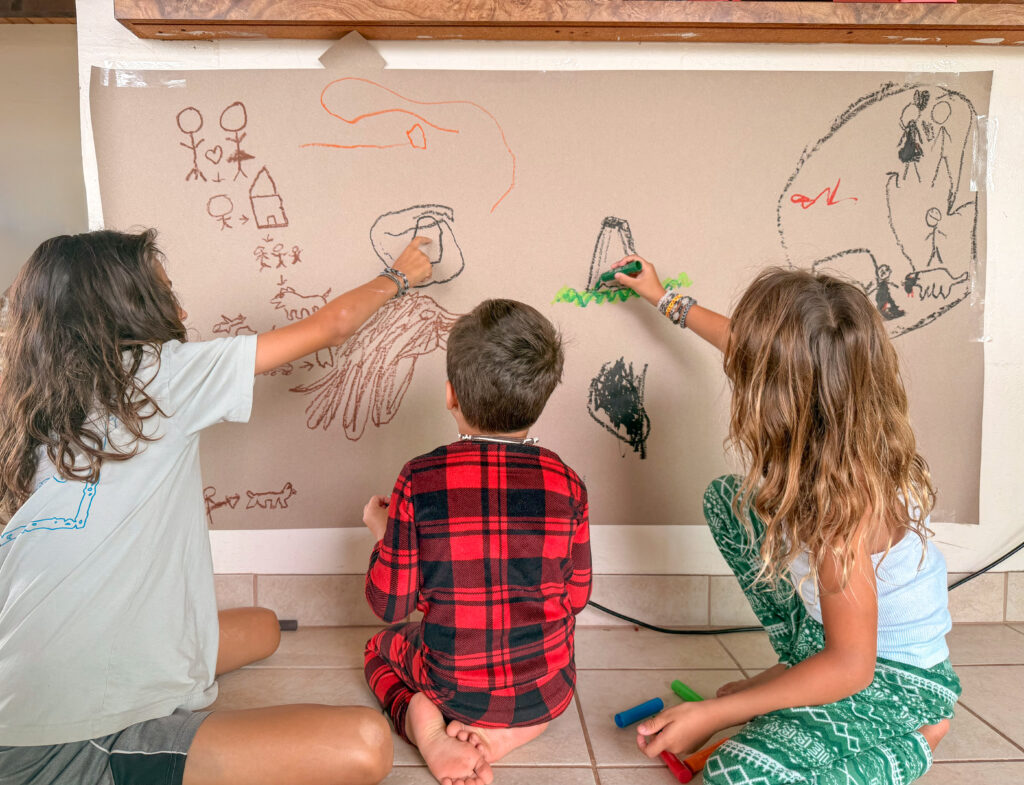
But…it’s also a wonderful addition to any study of ecosystems, conservation, environmental science, or genetics. Instead of stopping at how species become extinct, your kids get to consider our responsibility to the natural world and the role modern science should play in shaping its future.
After the debate, it would be so fun to pull out a few nature documentaries and learn more about the incredible animals that once walked the Earth. Compare extinct animals to endangered ones and ask an even bigger question: should our focus be on bringing animals back, or protecting the ones we still have?
I also think this would be the perfect excuse for a trip to the zoo or a natural history museum. There’s something special about standing in front of an exhibit and realizing these conversations aren’t just theoretical. They’re connected to the world around us. I love this debate because it reminds kids that science isn’t just about discovering what’s possible. It’s also about thinking carefully about the responsibility that comes with those discoveries.
Here are some great extension activities and conversation starters for after your debate:
- – Research an extinct animal and create a one-page fact sheet about its habitat, diet, and why it became extinct.
- – Compare an extinct species to a similar endangered animal that’s alive today.
- – Ask: If you could bring back one extinct animal, which would you choose and why?
Perfect to use when studying: Paleolithic Era; early humans; extinction and endangered species; ecosystems; environmental science, conservation, STEM; genetics and DNA; scientific ethics
Should Companies Advertise to Kids?
I hope you’re starting to see how you can bring homeschool lessons to life with debate! This debate is such a fun way to connect learning to everyday life because once you start noticing advertising…you can’t stop seeing it.
I’d probably turn this into a family challenge. The next time we went to Costco, Target, or even the grocery store, I’d ask my boys to become advertising detectives. Which products seem to be designed specifically for kids? What colors, characters, or packaging are grabbing their attention?
Back at home, we’d keep the conversation going by watching a few commercials together and talking about the different ways companies persuade us to buy something. I think it would be especially fun to compare advertisements aimed at children with advertisements aimed at adults.
I love this debate because it helps kids become thoughtful consumers. Instead of simply being influenced by advertising, they begin recognizing the strategies behind it.
Here are some great extension activities and conversation starters for after your debate:
- Go on an “advertising scavenger hunt” at the grocery store.
- Watch a few commercials together and identify persuasive techniques.
- Compare packaging for products marketed to kids versus adults.
- Design two advertisements for the same product: one for children and one for adults.
- Keep an “advertising journal” for one day and notice how many ads you encounter.
- Ask: Should companies have different rules when advertising to children than adults? Why or why not?
Perfect to use when studying: Entrepreneurship and business; Economics; Financial Literacy; Psychology; Graphic Design; Persuasive Writing; Communication
Are Robots Good for Humanity?
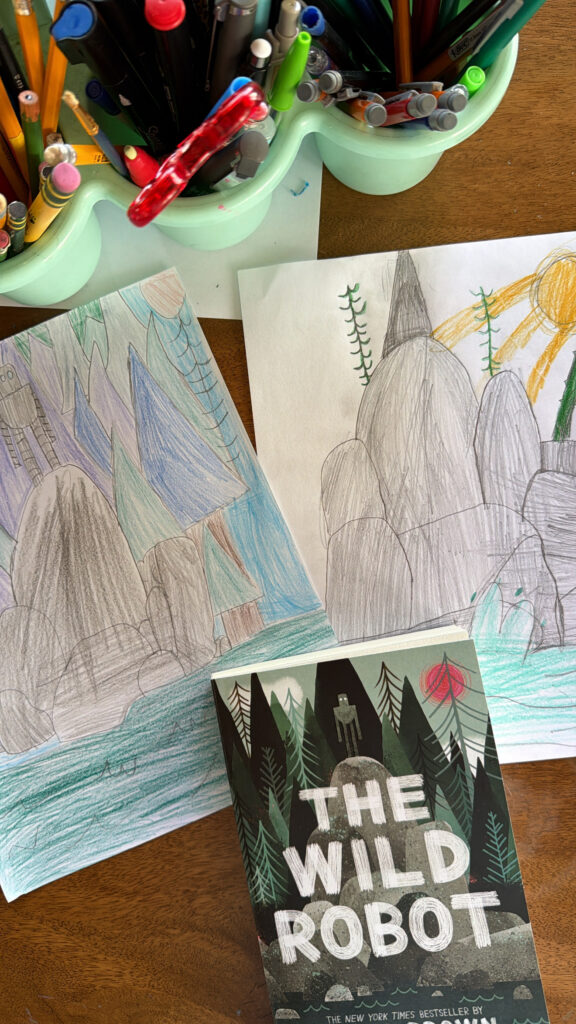
This debate feels more relevant than ever because technology is changing so quickly, and our kids are growing up in a world that will likely look very different from the one we grew up in.
If you’re studying robotics, coding, engineering, inventors, or even the Industrial Revolution, this debate is a wonderful way to connect those lessons to questions we’re facing today.
It’s also a natural fit for discussions about artificial intelligence, future careers, and how innovation continues to shape the way we live and work.
After the debate, I’d start pointing out all the ways we already interact with robots and artificial intelligence in everyday life. From self-checkout machines and robotic vacuums to AI-powered tools, they’re everywhere once you begin looking.
Ask your kids to imagine the future. What jobs do they think robots could do well? Which jobs should always require a human? What inventions do they hope someone creates in their lifetime? I also think this would be a fun opportunity to become inventors ourselves. Give your kids some recycled materials or LEGO bricks and challenge them to design a robot that solves a real problem for your family. What would it do? Who would it help?
Here’s some great extension activities and conversation starters for after your debate:
- Keep a list of every robot or AI your family interacts with in a single day.
- Research an inventor whose invention changed everyday life.
- Design or build a robot that solves a real-world problem.
- Watch a documentary about robotics or artificial intelligence and discuss what surprised you.
- Write or illustrate “A Day in My Life 50 Years From Now.”
- Ask: If robots could do every job in the world except one, which job should always belong to humans? Why?
Perfect to use when studying: Robotics; Artificial Intelligence; Coding and Computer Science; Engineering and STEM; Inventors and Inventions; Industrial Revolution; Careers; Scientific Ethics
One Debate. Endless Possibilities.
One of my favorite things about homeschooling is that learning rarely stays inside one subject. A history lesson turns into a geography rabbit trail. A science experiment sparks a conversation about ethics. A simple question asked over breakfast becomes a debate the whole family is still talking about at dinner.
That’s exactly what I hope these debate kits become in your home. A way to bring homeschool lessons to life with debate!
Not another workbook to finish.
Not another assignment to check off.
But a starting point.
A starting point for meaningful conversations, unexpected rabbit trails, and the kind of critical thinking that can’t be measured with a multiple-choice test. Whether your child loves history, science, technology, cooking, or simply asking “why,” my hope is that these debates help you discover something even more important than the answer.
The joy of thinking.
Ready to start Debating?
If you’ve made it this far, I hope you’re beginning to see what we envisioned when we created That’s Debatable!
These aren’t just debate topics. They’re an invitation to bring homeschool lessons to life with debate. To ask thoughtful questions. To practice critical thinking!
Each debate kit includes everything you need to jump right in:
- An engaging story to introduce the topic
- A lesson that teaches kids how debate works
- Three curated research articles that present multiple perspectives
- An argument builder to organize their thinking
Simply choose any three debate topics to build your custom kit, and we’ll take care of the rest.
I can’t wait to hear which debate your family starts with first!
View comments
+ Leave a comment